How to Choose Interior Paint Colors for Your OKC Home
How to Choose Interior Paint Colors for Your Oklahoma Home
Overview
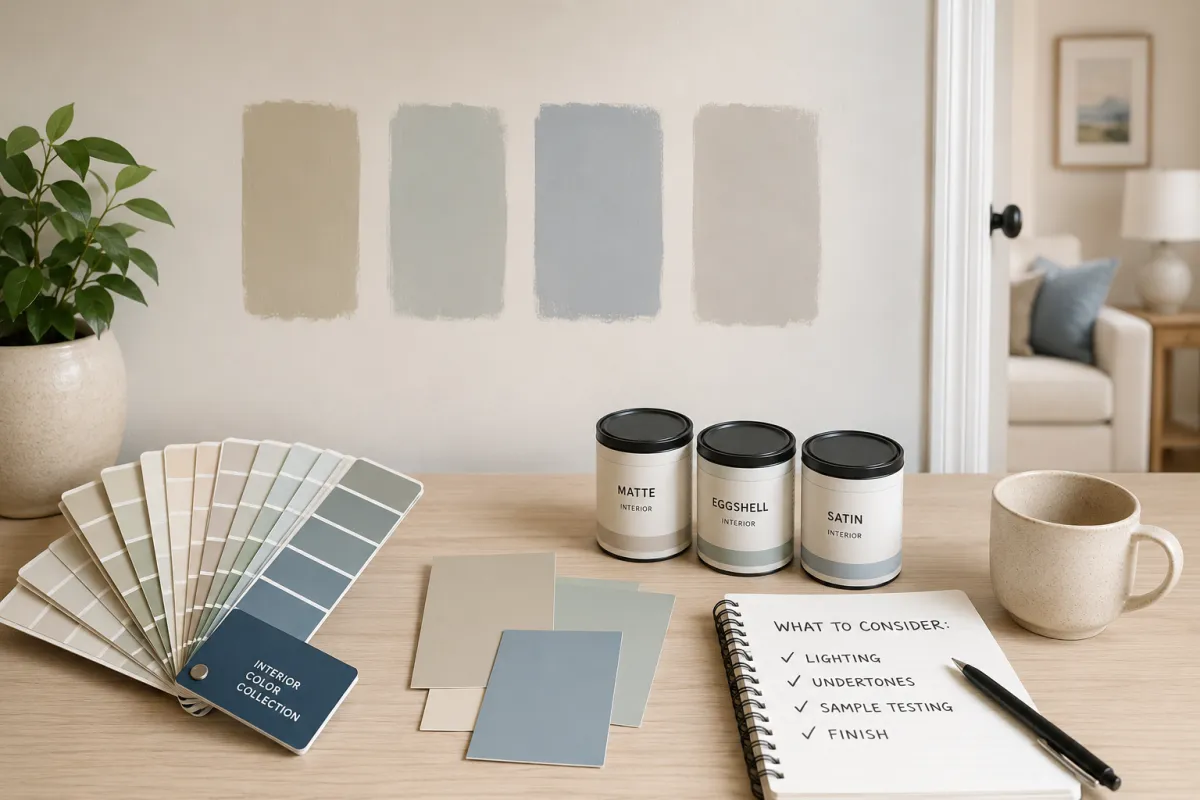
Choosing interior paint colors for an Oklahoma home comes down to testing samples in your actual lighting, understanding warm and cool undertones, and matching the finish type to how the room gets used. Oklahoma's mix of bright south-facing exposure and flat, overcast winter days changes how a color reads on the wall, sometimes dramatically. A gray that looks warm and soft in the store can go blue and cold in a north-facing OKC living room. Sample boards beat paint chips every time, and 48 hours of living with a color beats a five-minute decision at the counter.
Request a Free Estimate. Thiessen Painting serves Yukon and the OKC metro. Reach out and we will help you get the color right before a drop goes on the wall.
Start With Light, Not Color
How OKC's South-Facing Light Changes a Color
South-facing rooms in Oklahoma get long, strong, warm light for most of the day, and that light amplifies whatever warmth is already in a paint color. A beige that seemed neutral on the chip can read distinctly yellow. A warm white can go cream.
If a room faces south, you generally have room to go cooler or more neutral than you think you want, because the light will add the warmth back. This is also where UV matters. Strong, sustained sun through a big south window will fade a saturated color over the years, so deep accent tones hold up better on walls that are not taking direct afternoon sun.
North-Facing Rooms and Why They Need Warmer Tones
North-facing rooms get indirect, cooler light with very little of the warmth that balances a color out. Grays turn blue, taupes turn purple, and crisp whites can read gray and flat, especially through an Oklahoma winter when we string together overcast days.
In a north-facing room, pick a color with a warm undertone even if warm is not the look you are after. Greige, warm white, and soft clay tones hold their character in that light. The undertone is the part people miss. Two grays with the same depth can behave completely differently depending on whether they lean green, blue, or violet underneath.
Test Like a Pro
Why Paint Chips Lie and Sample Boards Do Not
A paint chip is two inches of color against whatever is behind it, held under store lighting. It cannot tell you much. Color reads differently at scale, and it reads differently against your floors, your trim, and your furniture.
Buy sample pots and paint two coats onto a piece of white poster board or primed drywall, roughly two feet square. Leave a white border around the edge so the surrounding color does not distort your read. Two coats matters, because a single thin coat over white will look lighter than the finished wall.
Where to Hold the Sample and How Long to Live With It
Move the board around the room. Hold it flat against each wall, prop it near the window, then set it on the wall farthest from the window. Look at it in the morning, at midday, and at night under your lamps and overheads. A color that works in daylight can turn on you completely under warm bulbs.
Give it at least 48 hours before you commit. If you have a room with a strong fixed element like brick, wood floors, or a stone fireplace, hold the sample right up against it. That relationship is permanent, and the paint is the piece that has to adapt.
Request a Free Estimate and Thiessen Painting will get back to you fast, and we are happy to talk through samples before you order paint.
Finish Selection: Where Most Homeowners Get It Wrong
Flat, Eggshell, Satin, and Semi-Gloss Explained Simply
Finish, or sheen, is how much light the paint reflects, and it controls both how the color looks and how the wall cleans up. Flat has no shine, hides wall imperfections better than anything else, and is the hardest to clean. Eggshell has a very slight sheen, cleans reasonably well, and is the everyday workhorse for walls. Satin has a noticeable soft shine, cleans well, and stands up to moisture. Semi-gloss is clearly reflective, very durable, and very washable.
One thing worth knowing: the higher the sheen, the more it shows every flaw in the drywall behind it. A semi-gloss wall in a room with wavy drywall will highlight every wave.
Best Finish for Each Room in an OKC Home
For most Oklahoma homes, this holds up well. Ceilings get flat. Bedrooms, living rooms, and formal dining rooms get eggshell. Hallways, kids' rooms, and playrooms get eggshell or satin, since they take the most hands and scuffs. Kitchens, bathrooms, and laundry rooms get satin, because our humidity runs 60 to 73 percent most of the year and those rooms add their own moisture on top of it. Trim, doors, and cabinets get semi-gloss for durability and for the visual break against the wall.
If you are moving up from builder-grade flat on new construction, going to eggshell on the walls is one of the highest-value changes you can make. It cleans, it holds up, and it does not look shiny.
Frequently Asked Questions
What is the most popular interior wall color in OKC right now?
Warm neutrals continue to lead: greige, soft warm whites, and light taupes with a warm undertone. They work with the brick and wood tones common across OKC metro homes, they hold up under both our bright summer light and flat winter light, and they do not date quickly. Cool grays have cooled off considerably from where they were a few years ago.
Should I use the same color throughout the whole house?
A single wall color throughout is a solid approach in open floor plans, and it makes touch-ups far easier down the road. The common refinement is running one neutral through the main living areas and hallways, then shifting to a different color in bedrooms, offices, or a feature space. What matters more than sameness is that adjacent colors share an undertone so the transitions do not clash.
How do I pick a color that works in both summer and winter light?
Test the sample board on an overcast day and on a bright day before deciding. Colors with a moderate warm undertone are the safest across seasons in Oklahoma, because they do not go cold when winter light flattens out or go garish when summer sun intensifies. Avoid highly saturated cool tones on any wall that gets a big swing in daylight.
Should ceilings always be white in Oklahoma homes?
White ceilings in a flat finish are still the default and they work, especially in rooms with standard eight or nine foot ceilings, because they bounce light and make a space feel taller. The main alternative worth considering is tinting the ceiling to about 25 to 50 percent of the wall color, which softens the contrast and reads well in bedrooms and rooms with tall or vaulted ceilings.
Ready to pick colors and get it painted right? Thiessen Painting offers free estimates across Yukon, Mustang, Edmond, Piedmont, and the OKC metro, with 31 years of experience behind every job. Request a Free Estimate to get started.